Industrial Pumps
Mono Pump
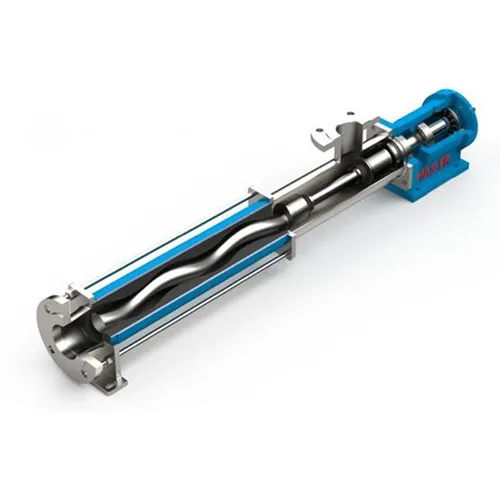
Mono pumps are progressive cavity (Moineau-type) positive-displacement pumps in which a single helical rotor turns eccentrically inside an elastomer stator, moving viscous, abrasive, solids-laden or shear-sensitive fluids at a steady, low-pulsation flow proportional to speed.
- Viscous
Media - Precise
Flow Control - Easy
Maintenance - Wide
Application
Gentle, Pulsation-Free
Flow for Viscous Media
A Mono pump is a progressive cavity pump, the design patented by René Moineau in 1930 and commercialised by Mono Pumps (today NOV Mono) in the UK from the 1930s. A single-helix metal rotor turns eccentrically inside a double-helix elastomer stator whose pitch is twice that of the rotor. The geometry forms a chain of sealed cavities that move continuously from suction to discharge without changing shape or volume, so the pump delivers a smooth, almost pulsation-free flow that is directly proportional to speed and nearly independent of discharge pressure.
Because the fluid is carried rather than flung, progressive cavity pumps handle what centrifugal pumps cannot: high viscosities, entrained solids and fibres, abrasive slurries, shear-sensitive products and gas-laden or multiphase mixtures, all at pressures that are stacked up stage by stage (roughly 6 bar per stage). They self-prime with suction lifts to 8 m and can run in either direction. Rotor and stator must stay wetted, so dry-run protection is normally fitted, and stator elastomer is selected for chemical and temperature compatibility.
- Positive
Displacement - Modular
Construction - Self-Priming
Up to 8 m - Solids
Handling

Technical Specifications
| Pump type | Progressive cavity (single helical rotor / eccentric screw, Moineau principle), positive displacement |
|---|---|
| Flow range | 0.1 to approx. 440 m³/h (dosing units from 1 L/h) |
| Differential pressure | Up to 6 bar per stage; 12 bar (2-stage), 24 bar (4-stage), 48–72 bar in special multi-stage designs |
| Viscosity range | 1 to 50,000 cSt standard; to over 1,000,000 cP with hopper / feed-screw designs |
| Solids handling | Soft solids and slurries to approx. 45 % dry solids; fibrous and abrasive media with wide-throat / macerator options |
| Self-priming suction lift | Up to 8 m (dry-running must be avoided) |
| Temperature range | -10 °C to +140 °C depending on stator elastomer |
| Rotor materials | Hard-chrome plated tool steel, 316 stainless steel, duplex, ceramic or tungsten-carbide coated |
| Stator elastomers | NBR (nitrile), EPDM, FKM (Viton), HNBR, natural rubber, PTFE-lined |
| Drive options | Fixed or variable-speed geared electric motor, air motor, diesel, hydraulic; close- or long-coupled; ATEX versions |
| Connections | Flanged DIN / ANSI, threaded or hygienic (Tri-Clamp, DIN 11851) 25 to 300 mm |
| Materials of construction | Cast iron, carbon steel or 316 stainless casings; mechanical or packed-gland shaft seal |
Materials
| Pump Body | Cast Iron GG25 or Stainless Steel AISI 316 |
|---|---|
| Rotor | Hardened Tool Steel, Chrome-plated, or Stainless Steel 316 |
| Stator | NBR, EPDM, FKM (Viton) or Natural Rubber |
| Drive Shaft & Joints | Stainless Steel, sealed pin joints |
| Shaft Seal | Mechanical seal or gland packing |
| Base Plate | Carbon steel, painted |
Performance Curve
- 1200 rpm
- 900 rpm
- 600 rpm
- 300 rpm
Dimensions
| Size | Connections | Length (mm) | Width (mm) | Height (mm) | Weight (kg) |
|---|---|---|---|---|---|
| PC 20 | DN 32 | 850 | 220 | 280 | 38 |
| PC 40 | DN 50 | 1,150 | 280 | 340 | 72 |
| PC 60 | DN 65 | 1,450 | 320 | 400 | 125 |
| PC 100 | DN 80 | 1,800 | 380 | 460 | 210 |
Typical dimensions for the model range; certified dimensional drawings are available on request.